
Oregon Notice of Right to Lien: How to Send Notice in Oregon
by Krista Lerma

Quick Answer: How Does an Oregon Notice of Right to Lien Work?
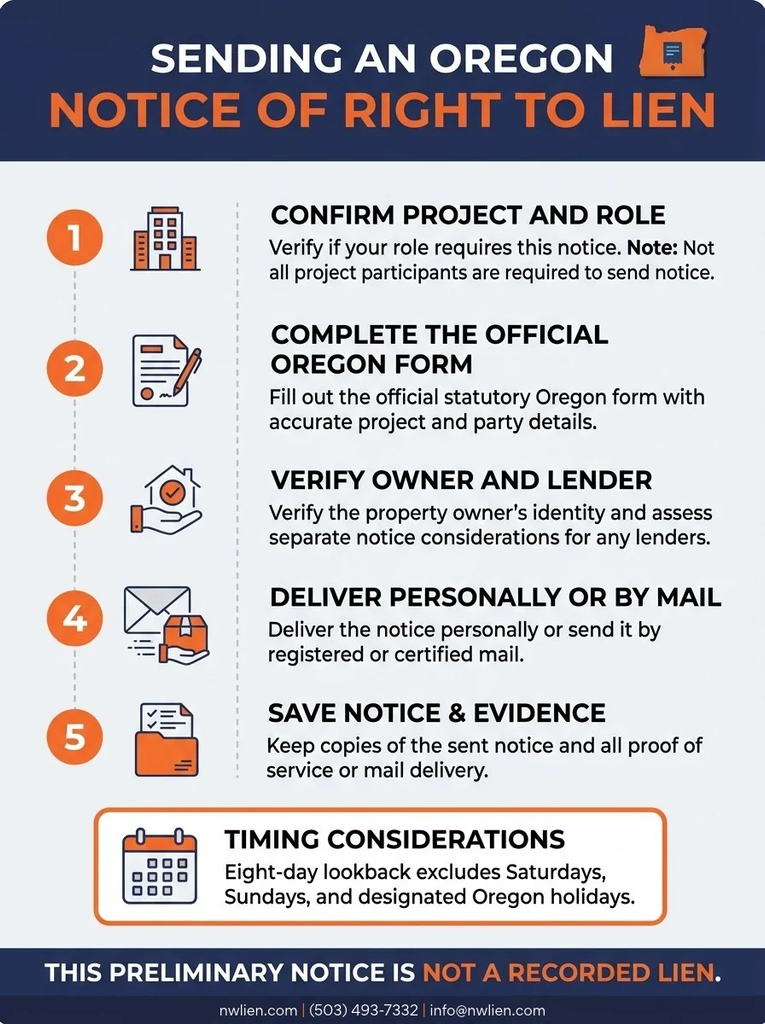
An Oregon Notice of Right to Lien helps preserve potential construction-lien coverage for qualifying work, materials, equipment, or services. When required, send it to the owner by personal delivery or registered or certified mail. Its coverage generally looks back eight days, excluding Saturdays, Sundays, and designated Oregon holidays, before mailing or delivery.
- Confirm whether your role and project require the notice.
- Use the official Oregon form and send it promptly after first furnishing.
- Keep the completed notice, recipient details, and service records.
Note: This notice is not a recorded lien, and later notice may leave earlier furnishing outside its coverage. Read our guide below, with links to Oregon statutes and the official CCB form. Updated November 2026.Reviewed for accuracy by lien specialists.
How Do I Send an Oregon Notice of Right to Lien?
Send the completed notice to the property owner using personal delivery or registered or certified mail. You don’t record this preliminary notice with the county or submit it to the Oregon Construction Contractors Board, or CCB.
Important: Before sending it, check whether the notice is required for your role and whether separate lender-notice considerations apply. Oregon’s delivery, notice, and form requirements appear in ORS 87.018, 87.021, and 87.023.
1. Confirm Your Role, Project Type, and First Furnishing Date
Identify who ordered your work, materials, equipment, or services. A direct relationship with the owner can change the notice requirement, and Oregon provides an exception for certain participants on commercial improvements.
Record these details before preparing the notice:
- Your business name and contact information.
- The person or company that hired you.
- The project address and the owner’s name and mailing address.
- The work, materials, equipment, or services you are providing.
- Your first furnishing date, meaning when you first provided the relevant work, materials, equipment, or services.
- Whether the building is or will be owner-occupied and how many residential units it contains.
Use the role-and-project table below before assuming that every subcontractor, supplier, or equipment lessor follows the same notice rule.
2. Complete the Oregon Notice Form
Use the official Oregon CCB Notice of Right to a Lien PDF. It includes the project fields and owner-protection information associated with the statutory notice.
Complete the owner and sender information, mailing date, hiring-party name, property location, and description of what you are providing. Keep all pages and required explanatory wording rather than replacing the notice with an invoice, a short demand letter, or a generic out-of-state form.
ORS 87.023 requires the notice to be substantially in the statutory form.
3. Check the Owner and Any Separate Lender-Notice Needs
Confirm the owner’s identity and mailing address before sending. Do not assume that the person approving invoices is the property owner.
If you furnish materials or supplies, also check whether a recorded mortgage or trust deed creates a separate notice issue. ORS 87.025(3) ties potential priority over a recorded mortgage or trust deed to timely notice to the mortgagee, meaning the lender or other holder of that security interest.
This is separate from sending the owner’s notice. It is not a universal instruction to send every project participant the same document. If the hiring party is a tenant, or ownership and financing details are unclear, get the project facts reviewed before choosing recipients or assuming which property interest a later lien could affect.
4. Deliver the Notice Using an Allowed Method
ORS 87.018 allows the following delivery methods:
- Personal delivery
- Registered mail
- Certified mail
For this notice, the statute does not expressly require return receipt requested. Certified-mail documentation and a return receipt can still help document the mailing and delivery history.
Do not rely on ordinary email, a text message, or an invoice attachment as a substitute for the statutory delivery methods. For the eight-day lookback, ORS 87.021 refers to the date the notice is delivered or mailed.
5. Save the Notice and Service Records
Keep a copy of the exact notice sent, including its additional pages. Save the recipient address, mailing receipt and tracking information, or a written record of personal delivery.
Connect those records to the project’s contract, first furnishing date, delivery tickets, invoices, and payment history. If the notice went out later than planned, identify the earlier furnishing that needs a separate coverage review instead of assuming the entire contract amount is protected.
Need help with preparation and mailing? Start an Oregon preliminary notice order with your project details and furnishing dates.
Who Needs to Send an Oregon Notice of Right to Lien?
The requirement depends on who requested the furnishing, what you supplied, and how the improvement is classified. Parties furnishing at the owner’s request generally fall outside the owner-notice requirement in ORS 87.021(1), while subsection (3)(b) creates an additional commercial-improvement exception.
| Your Role and Project | General Notice Rule | What to Verify |
|---|---|---|
| Furnishing directly at the owner’s request | Generally not required under ORS 87.021(1). | Original contractors may have a separate Information Notice to Owner obligation on qualifying residential contracts. |
| Materials supplied through a contractor or another non-owner party | Generally required. | The owner, first delivery date, and separate mortgagee-notice considerations. |
| Labor or labor and materials on an owner-occupied residential building with no more than four units, without a direct owner contract | Generally required. | Owner occupancy, unit count, and the hiring relationship. |
| Labor or labor and materials on a commercial improvement | Generally exempt under ORS 87.021(3)(b). | The statutory project classification, not just the project’s everyday label. |
| Equipment rented for a commercial improvement | Generally exempt under the commercial-improvement exception. | Whether the project qualifies for that exception. Do not automatically apply it to an owner-occupied residential project. |
| Design, surveying, engineering, or similar professional services | Requires a closer eligibility review. | Specific restrictions apply to certain services requested by an owner’s agent for an owner-occupied residence. |
Source: ORS 87.010 and 87.021. These general rules do not establish that an individual claim qualifies. On smaller screens, scroll horizontally to view all columns.
Project labels can be misleading. For this notice exception, Oregon defines a residential building as one occupied or intended to be occupied by the owner as a residence, containing no more than four dwelling units. A rental property or larger residential building may therefore need a different analysis than its everyday “residential” label suggests.
What Is an Oregon Notice of Right to Lien?
An Oregon Notice of Right to Lien, also called a Notice of Right to a Lien, tells an owner that the sender is providing materials, equipment, labor, or services to the property. Where required, it helps preserve the sender’s ability to include qualifying furnishing in a later construction-lien claim.
The statutory form expressly states, “THIS IS NOT A LIEN.” It is not a recorded claim, a demand for immediate payment, or proof that anyone has failed to pay.
A notice of intent to lien is a different type of communication, commonly used to warn that a lien may follow a payment problem. Do not substitute that wording or a payment-demand letter for Oregon’s statutory preliminary notice.
When Should I Send the Notice, and What If I Send It Late?
Send the notice promptly after you begin furnishing, rather than waiting for an overdue invoice. Oregon permits the notice during the progress of the improvement, but its coverage generally reaches back only eight qualifying days before mailing or delivery.
Later notice is not automatically invalid simply because more than eight days have passed since your first furnishing. Instead, earlier materials, equipment, labor, or services may fall outside the notice’s coverage.
How Do I Count the Eight-Day Lookback?
Exclude Saturdays, Sundays, and the Oregon holidays identified in ORS 187.010. Do not treat “eight days” as eight consecutive calendar days.
For a notice sent after work has begun:
- Establish the mailing or personal-delivery date.
- Review the preceding eight qualifying days.
- Match furnishing records against the coverage language in ORS 87.021.
- Flag older deliveries or work for review.
The practical distinction is between “the notice was sent” and “all earlier furnishing is covered.” Those are not necessarily the same conclusion. Confused? Talk to our lien specialists.
Does Late Notice Extend the Lien-Recording Deadline?
No. Sending a preliminary notice does not restart the separate construction-lien recording period.
For the labor, material, and equipment claims addressed by ORS 87.035(1), the recording deadline is generally 75 days after the claimant stops furnishing or 75 days after completion of construction, whichever is earlier. Other claimant categories can have a different trigger under that section.
If the project is ending or an invoice is already overdue, review our Oregon mechanics lien filing guide.
How Much Does It Cost to Send an Oregon Preliminary Notice?
DIY costs depend on your delivery method, current postal charges, and the time spent checking project details, preparing the form, and maintaining records.
If you use an Oregon lien service, confirm the notice price, recipients included, mailing method, and any additional charges before ordering.
NWL’s preliminary notice service describes project-information research, state-specific document preparation, certified mailing with tracking, and a copy for your records.
How much does it cost to send a notice with Northwest Lien?
For a flat fee of $45, our lien specialists handle document preparation, and certified mailing to the property owner.
You provide the project details and review. We take care of preparing and sending it, so you can stay focused on your work.
Start Your Oregon Notice OrderCan I send my Oregon notice myself?
DIY can make sense when you can verify the project information and manage preparation, mailing, and records yourself. NWL is an alternative when you want a notice service to handle those administrative tasks and avoid errors.
| Task | Do It Yourself | Northwest Lien Service |
|---|---|---|
| Project and Recipient Research | You identify and verify relevant project parties and addresses. | NWL’s published process includes checking owner, general contractor, and lender information. |
| Notice Preparation | You complete the Oregon form and retain its required wording and pages. | NWL prepares state-specific preliminary notice documents. |
| Mailing | You arrange an allowed delivery method and retain supporting records. | NWL’s published service includes certified mailing with tracking. |
| Document Copy | You organize the sent version and mailing records in your project file. | NWL provides a copy for your records. |
| Cost and Timing | You pay delivery costs and manage the work internally. | Confirm the current notice fee, included recipients, and mailing date before ordering. |
Northwest Lien Customer Review
Northwest Lien has processed thousands of mechanics lien filings in the PNW and California since 1999 and has collected over $250 million for our clients. We stay up to date with all state codes and compliance changes to help make filing simple and stress-free for you.
” NW Lien has assisted our company with several claims and they have all ended with us getting paid. Their customer service is great, informative and they have made the process very easy. Ken and his staff always deliver top notch customer service, they are amazing to work with, highly recommend working with them.”
Samantha Peart
FAQs
Does a notice of intent to lien need to be notarized?
No. A Notice of Intent to Lien (or Notice of Intent to Foreclose) in Oregon does not need to be notarized.
How do I file an Oregon Notice of Right to Lien?
You send an Oregon Notice of Right to Lien to the owner rather than file it with the county recorder or the CCB. Complete the Oregon notice, check whether it applies to your role and project, and deliver it personally or by registered or certified mail. Keep the sent document and service records. If you mean recording a construction lien for unpaid work, that is a separate process with different document requirements and deadlines.
Where can I download Oregon Notice of Right to Lien forms online?
Download the official Notice of Right to a Lien PDF from the Oregon CCB. The CCB Contractor Tools page also lists the notice. Use the complete document and confirm that its project fields are accurate. NWL does not offer an Oregon Notice of Right to Lien template download; its separate preliminary notice service is available if you want help preparing and sending the notice.
Is the Oregon CCB Notice of Right to Lien the same as the Information Notice to Owner?
No. The Notice of Right to Lien addresses the sender’s involvement and potential lien coverage, while the Information Notice to Owner is a separate disclosure associated with an original contractor’s qualifying residential contract. Sending one does not automatically satisfy the other. If you contract directly with a homeowner, check the CCB’s Information Notice to Owner requirements instead of assuming the subcontractor or supplier notice is the document you need.
Does receiving a Notice of Right to Lien mean the contractor has not been paid?
No. The notice can be sent early in the project before any payment dispute exists, and it does not itself place a recorded lien on the property. It tells the owner who is providing work, equipment, materials, or services and explains potential lien exposure if that provider is not paid. Owners should retain the notice, match it to the project, and include the sender in their payment-verification records.
Can a property owner request details after receiving the notice?
Yes. ORS 87.027 allows an owner who receives the notice to request specified details in writing, including a description or list of what was supplied, the contractual basis, and applicable charges. The supplier’s response is due within 15 days after receiving the written demand, excluding Saturdays, Sundays, and designated holidays. If you receive a request, document the receipt date and respond promptly because failure to provide the information can affect recoverable fees and costs.
Oregon Notice and Construction Lien Resources
Primary Oregon Sources
- ORS Chapter 87: Construction lien and notice requirements. Relevant sections include 87.018 for delivery, 87.021 for notice coverage and exceptions, 87.023 for the form, 87.025 for priority considerations, 87.027 for owner information requests, and 87.035 for recording requirements.
- Official CCB Notice of Right to a Lien PDF
- CCB Contractor Tools
- CCB Information Notice to Owner About Construction Liens
Related Northwest Lien Guides
Disclaimer: This article is for informational purposes only and does not constitute legal advice. Mechanics lien laws are complex and vary by jurisdiction. For specific legal guidance regarding your situation, please consult with a qualified local attorney.