Complete Guide: How to Become a General Contractor in Washington State
by Michelle McCullum

Quick Answer: How to Become a General Contractor in Washington State
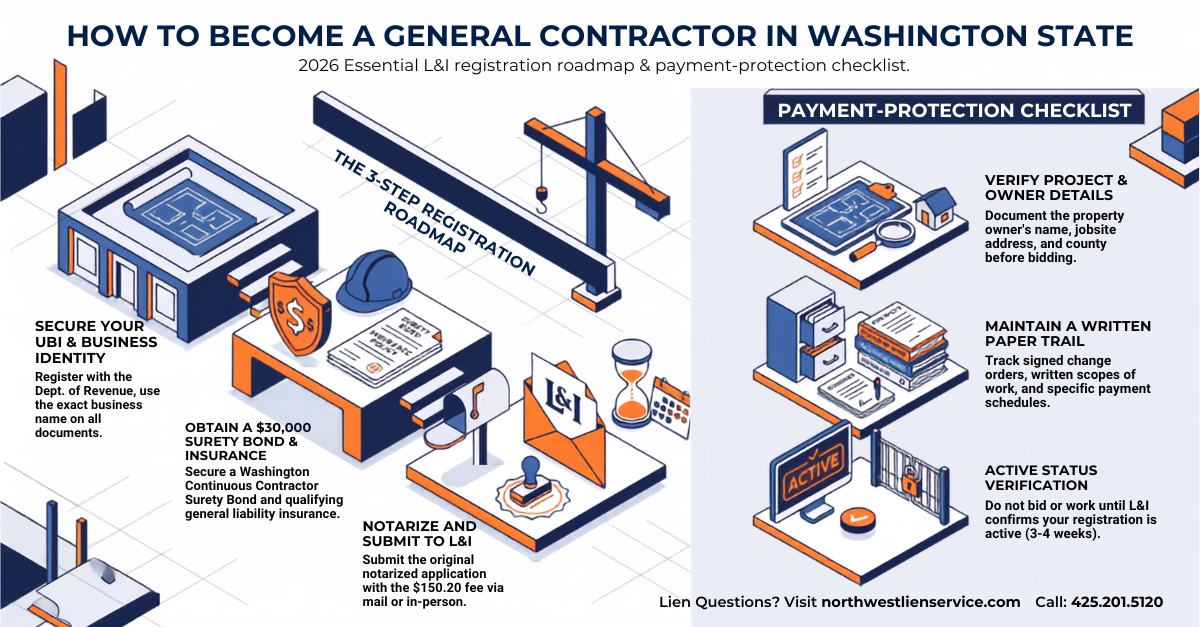
To become a general contractor in Washington, register with the Washington State Department of Labor & Industries (L&I). You need a UBI number, a $30,000 contractor bond, qualifying liability insurance, and an original notarized application with the $150.20 registration fee.
- Step 1 – Register Your Business: Obtain a Washington UBI number and use your legal business name consistently.
- Step 2 – Prepare Required Documents: Obtain the required contractor bond and general liability insurance.
- Step 3 – Apply With L&I: Submit your original notarized application, supporting documents, and registration fee.
Note: Verify current fees, requirements, and submission instructions with L&I before applying, as they can change. Read our guide below, reviewed by local lien specialists. Updated August 2026.
In This Guide:
- Video Guide: Registering as a WA Contractor
- Choose Your Contractor Registration Type
- Step-by-Step Guide: How to Get Registered
- Can You Get a General Contractor License Online?
- How Much Does It Cost to Become a General Contractor?
- What to Do Before You Bid Your First Project
- Frequently Asked Questions
- Related Washington Contractor Resources
Video Guide: How to Register as a GC in Washington
Watch this short video for a practical overview of the business setup, bond, insurance, and registration steps to prepare before applying with Washington L&I.
Choose Your Contractor Registration Type
Washington generally requires construction contractors to register with L&I. “General contractor license” is a common search term, but the standard state process is contractor registration.
Choose your registration type based on the work your business will perform.
- A general contractor may manage broad construction work and hire subcontractors.
- A specialty contractor is registered for specific types of work.
Electrical, plumbing, and certain other regulated trades can require separate licenses, certified workers, permits, or designated qualified individuals.
IMPORTANT NOTE
General contractor registration does not automatically authorize every type of trade work.
Choose Your Contractor Registration Type
Use this comparison to identify the registration path that best matches your planned work.
| Registration Type | Typical Use | Bond Requirement | Key Point |
|---|---|---|---|
| General Contractor | Broad construction work, project management, or hiring subcontractors. | $30,000 | May perform more than one construction trade, but regulated work may require separate licensing or qualified workers. |
| Specialty Contractor | Work limited to one or more defined contractor specialties. | $15,000 | Your work should stay within the specialty or specialties listed on your registration. |
| Electrical Contractor | Electrical or telecommunications contracting work. | Separate requirements apply. | Requires a separate L&I electrical contractor license. |
| Plumbing Contractor | Plumbing contracting work. | Separate requirements apply. | Requires separate Washington plumbing contractor licensing. |
REMINDER BEFORE BUYING BONDS
Do not buy your bond or insurance until you know the legal business name and registration type you will use on the application.
Step-by-Step Guide: How to Get a General Contractor License
Step 1: Set Up Your Washington Business and UBI Number
Before applying for contractor registration, choose and establish your business structure. Depending on your situation, you may operate as a sole proprietor, a partnership, a corporation, or a limited liability company.
You will also need a Unified Business Identifier (UBI) number. Washington contractors generally obtain this through the Department of Revenue’s business registration process.
As you set up the business, make sure the legal business name is consistent across:
- Your business-registration records
- Your contractor bond
- Your liability-insurance policy
- Your L&I contractor-registration application
- Your contracts, invoices, bids, and advertising
Using slightly different versions of a business name can cause avoidable delays. For example, “Evergreen Build Co. LLC” and “Evergreen Building Company” may not be treated as interchangeable by an insurer, surety company, customer, or government agency.
Step 2: Get a Washington Contractor Bond
Washington requires a continuous contractor bond or an assignment of savings as part of the registration process.
- A general contractor needs a $30,000 bond.
- A specialty contractor needs a $15,000 bond.
The bond amount is not necessarily the amount you pay out of pocket. A surety company typically charges a premium based on factors such as the applicant’s credit, business history, and underwriting requirements. Compare quotes, but also verify that the bond is issued for the exact legal business name you will use for registration.
A contractor bond is not the same thing as liability insurance. Both are separate registration requirements.
Step 3: Purchase Required Liability Insurance
Washington L&I requires contractor applicants to carry qualifying general liability insurance. The policy must provide either:
- $200,000 in public liability coverage and $50,000 in property-damage coverage; or
- $250,000 combined single-limit coverage.
The insurance documentation should use your exact business name, and L&I must be listed as the certificate holder. Before paying for a policy, confirm with your agent that it meets Washington’s contractor registration requirements.
If you hire employees, you may also have workers’ compensation and other employer obligations. Discuss those needs with the appropriate state agencies and qualified insurance professionals, rather than assuming that a basic general liability policy covers your entire operation.
Step 4: Complete and Notarize the Registration Application
Complete L&I’s Application for Contractor Registration carefully. The application requires original signatures, which must be notarized.
Before submitting it, review every item:
- Legal business name
- Business structure and UBI number
- Contractor classification
- Bond information
- Insurance information
- Applicant signatures
- Notarization
- Registration fee
This is a good point to slow down. A rushed application can delay your ability to begin operating under an active registration.
Step 5: Submit Your Application to L&I
For an initial contractor registration, Washington L&I requires original application materials. You can visit a local L&I office for assistance or mail the completed, signed, and notarized application packet to L&I.
Your packet generally includes:
- The original notarized Contractor Registration Application
- Your continuous contractor bond or assignment-of-savings documentation
- Your certificate of general liability insurance
- The required registration fee
Keep copies of your submitted documents, policy declarations, bond paperwork, and proof of payment in a dedicated compliance folder.
TERMS DISTINCTION
Although the term “general contractor license” is common, Washington state law issues a Contractor Registration. Trades like electrical, plumbing, or elevator work require separate licenses before registering as a general contractor.
Infographics Guide: WA Contractor License Application
Can You Get a General Contractor License Online in Washington?
Not entirely. You can complete several early steps online, including researching requirements, registering a business, and communicating with insurers or bond providers. However, L&I’s initial contractor-registration process requires original, notarized application materials.
That means the practical process is usually a mix of online preparation and an in-person or mail submission. Do not wait until you are ready to sign a contract to begin; give yourself time to gather the required documents and correct any inconsistencies.
How Much Does It Cost to Become a General Contractor in Washington?
The direct L&I contractor-registration fee is currently $150.20. Your total startup cost will be higher because you must also obtain a contractor bond and liability insurance.
Your total may vary based on:
- Whether you register as a general or specialty contractor
- Your bond premium and underwriting profile
- Your insurance premium, coverage needs, and claims history
- Your business-formation costs
- Whether you will hire employees
- Whether your work requires separate electrical, plumbing, or other trade credentials
The $30,000 general-contractor bond is the required bond amount, not necessarily the premium you pay to the surety company. Ask for a written quote and compare the policy terms, not just the price.
What to Do Before You Bid Your First Project
Contractor registration is only the first operational step. Before bidding, build a repeatable process for collecting project and payment information.
- The customer’s exact legal name
- The property owner’s name
- The jobsite address and county
- The general contractor’s name, if you are a subcontractor or supplier
- A written scope of work, contract amount, payment schedule, and change-order process
- Invoice dates and payment follow-up records
Before your first project begins, set up both your job-payment workflow and back-office systems. Northwest Lien Service can help you prepare for preliminary notices, while our partner, Everline Accounting, provides bookkeeping and payroll support for growing construction businesses.
If a payment issue develops after work starts, read our guide to the Washington Notice of Intent to Lien.
FAQs: Becoming a General Contractor in Washington
Is it hard to become a general contractor in Washington?
The standard contractor-registration process is manageable when you prepare the required documents in the correct order. Most delays stem from administrative issues, such as selecting the wrong registration type, using inconsistent business names, submitting incomplete bond or insurance documents, or failing to notarize the application. The process can be more involved if your business performs regulated trade work or employs workers.
How long does Washington contractor registration take?
For mailed applications, L&I currently estimates 3–4 weeks from receipt of a complete application to process and activate the registration. Your overall timeline can be longer if you still need a UBI number, bond, insurance, corrected paperwork, or additional trade credentials. Start before you plan to advertise, bid, or begin work.
Is it worth being your own general contractor?
Yes, it can be worth acting as your own general contractor when you have the time, construction knowledge, and project management skills to coordinate permits, schedules, budgets, trades, contracts, and jobsite decisions. It may not be a good fit if you cannot assess bids, manage subcontractors, or handle project delays. This is different from starting a professional contracting business.
Do I need a separate electrical or plumbing license?
Possibly. General contractor registration does not automatically authorize a business to perform electrical or plumbing work. Washington regulates those trades separately, and the work may require a licensed contractor, a qualified designated individual, a certified worker, a permit, or an inspection. Confirm the requirements that apply before contracting for regulated trade work.
What should I do after my contractor registration becomes active?
Build your operating system before taking on projects. Use written contracts, maintain clear scopes of work, collect full project information, document changes, track invoices, and establish a payment-protection process. A consistent workflow is easier to maintain from your first project than to build after a payment issue arises.
How can customers verify my Washington contractor registration?
Customers can use Washington L&I’s Verify a Contractor, Tradesperson, or Business tool to check whether a contractor has an active registration. Keep your business information current and use your active registration number accurately in advertising, contracts, and other business materials.
Related Washington Contractor Resources
- What Can General Contractors Do in Washington State?
- How to File a Mechanic’s Lien in Washington State
- Washington Mechanic’s Lien Guides and FAQs
Already registered? Prepare for your first project with Northwest Lien
Once your Washington contractor registration is active, create a consistent process for project records, notices, and payment follow-up before your first project begins.
Northwest Lien helps thousands of contractors manage construction payment documentation and lien-related filings since 1999.
Ready to organize your payment-protection workflow? Create a free account or contact Northwest Lien for questions. Call 425-201-5120.