How to File a Mechanics Lien in Washington: Step-by-Step Guide 2026
by Lori Shaffer

Quick Answer: How to File a Mechanics Lien in Washington State
To file a mechanics lien in Washington State, confirm your lien eligibility and applicable notice requirements, then prepare and notarize a Claim of Lien. File it for recording with the county auditor or recorder where the property is located no later than 90 days after you last furnished qualifying labor, professional services, materials, or equipment.
- Check whether you need a Notice of Right to Claim Lien or a contractor disclosure statement. Requirements depend on your role and project type.
- Prepare, sign, notarize, and file your Claim of Lien for recording in the correct county before the recording deadline.
- Send a copy to the owner or reputed owner within 14 days of filing for recording. If payment remains unresolved, track the general eight-calendar-month enforcement deadline.
Washington does not have one preliminary-notice rule for every claimant. Read the notice requirements below before relying on a 60-day or 10-day timeline. The recording and owner-delivery requirements appear in RCW 60.04.091.
Last updated: October 2026. Reviewed for accuracy by local lien specialists.
Sounds overwhelming? We can help.
Order Washington Mechanics LienAn unpaid construction invoice can leave you covering labor, materials, and equipment costs long after the job is finished. A Washington mechanics lien can help secure a qualifying payment claim against the property you improved, but protecting that claim requires more than completing a form.
This guide explains how to file a lien in Washington State for a private construction project, including eligibility, required notices, document preparation, county recording, and the next steps. It also explains what Northwest Lien handles if you prefer help with the filing process.
What Is a Mechanics Lien in Washington State?
A mechanics lien is a legal claim against real property for qualifying unpaid construction work or contributions to an improvement. In Washington, construction liens can secure payment for labor, professional services, materials, or equipment furnished at the owner’s request or the request of an authorized agent under RCW 60.04.021.
You may also hear the terms contractor’s lien, construction lien, or materialman’s lien. Recording a lien does not automatically produce payment, and it is not a way to attach every type of unpaid debt to someone’s property.
Who Can File a Mechanics Lien in Washington?
Eligible claimants may include:
- general contractors
- subcontractors
- laborers
- material suppliers
- equipment lessors
- design professionals who furnish qualifying contributions to a property improvement.
Your right to file depends on the work supplied, your contractual relationship, applicable registration or licensing requirements, and compliance with required notices.
Contractors and subcontractors should verify any registration or licensing required for their work. RCW 60.04.041 addresses registration and licensing in establishing lien rights. Do not assume that every claimant’s rights disappear because another participant on the project has a registration problem.
Do You Need a Notice of Right to Claim Lien?
Not every Washington claimant must send a preliminary notice. A Notice of Right to Claim Lien, also called a Notice to Owner, is generally required for certain parties furnishing professional services, materials, or equipment who do not contract directly with the owner. However, the law includes important exemptions and special residential rules.
Use the following overview to identify which part of RCW 60.04.031 may apply to your project.
Table Summary: Who Needs to File a Notice
| Your Role or Project | Notice Rule | What to Check |
|---|---|---|
| You contract directly with the owner or the owner’s common law agent | A Notice of Right to Claim Lien is not required. | A separate contractor disclosure statement may still be required. |
| Your claim is based solely on performing labor | Labor-only claimants are exempt from this preliminary-notice requirement. | Do not assume a claim that includes materials or equipment qualifies for the labor-only exemption. |
| You are a subcontractor contracting directly with the prime contractor | Generally exempt, except for the applicable existing owner-occupied residential rule. | Check whether the project is a repair, alteration, or remodel of an existing owner-occupied single-family residence. |
| Notice-required claimant on a commercial or other project subject to the general rule | Notice generally protects qualifying furnishing within the preceding 60 days and afterward. | Sending notice early helps avoid losing protection for earlier furnishing. |
| Notice-required claimant on new construction of a single-family residence | The backward-looking protection period is 10 days, not 60 days. | This is not a general 10-day commercial-project rule. |
| You furnish professional services, materials, or equipment for an existing owner-occupied single-family repair, alteration, or remodel without contracting directly with the owner | Notice is required. Lien recovery is limited by amounts the owner has not yet paid the prime contractor when notice is received. | A simple 60-day or 10-day deadline does not adequately describe this rule. |
When notice is required, send it to the owner or reputed owner using the statutory delivery method. Certain claimants must also notify the prime contractor under RCW 60.04.031. Keep the notice and evidence of mailing or delivery with your project records.
What Disclosure Must Direct-Owner Contractors Provide?
The Notice to Customer, often called the Model Disclosure Statement, is different from a Notice of Right to Claim Lien. Under RCW 18.27.114, covered contractors must provide this disclosure before starting qualifying work.
- Residential projects: Repair, alteration, or construction of four or fewer residential units, or accessory structures on that property, when the bid or contract price is $1,000 or more.
- Commercial projects: Repair, alteration, or construction of a commercial building when the bid or contract price is $1,000 or more but less than $60,000.
- The contractor must retain a customer-signed copy for at least three years. The statute excludes contractors contracting with other contractors and certain public contracts.
A contractor subject to this requirement must prove that the disclosure was provided to bring or maintain the covered lien claim. Do not assume that a signed construction contract substitutes for the required disclosure.
Is a Notice of Intent to Lien Required?
A Notice of Intent to Lien is a payment warning, not the same document as a Notice of Right to Claim Lien. Washington’s mechanics lien statute does not generally require this warning before recording a Claim of Lien. Sending one does not replace a required preliminary notice or extend your recording deadline.
Learn more about the distinction in our guide to Washington Notices of Intent to Lien.
Washington Mechanics Lien Form and Checklist
The document used to record a Washington mechanics lien is a Claim of Lien. RCW 60.04.091 provides the required contents and a sample statutory form. A substantially compliant document must also meet the county’s recording requirements.
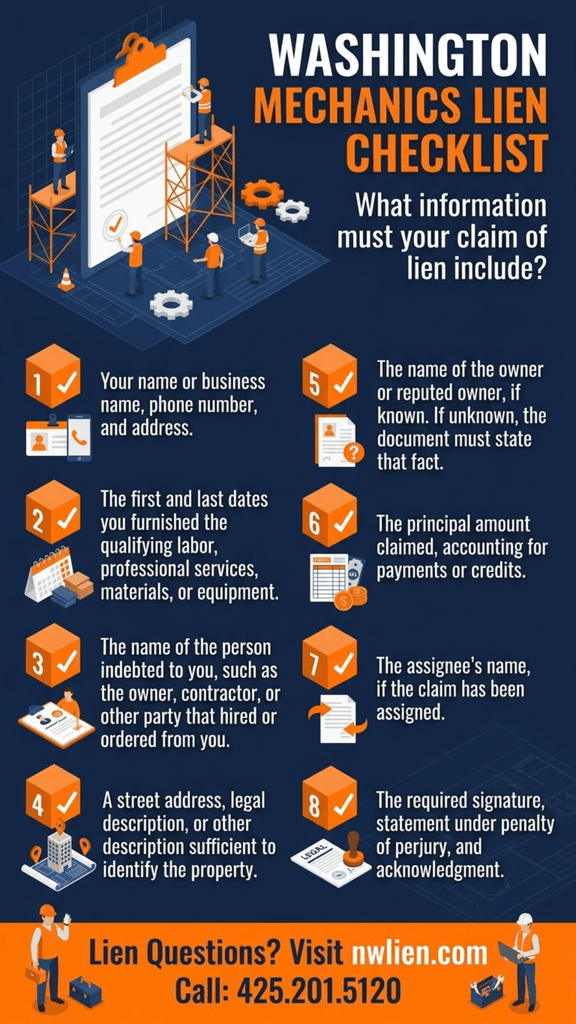
What Information Must Your Claim of Lien Include?
- Your name or business name, phone number, and address.
- The first and last dates you furnished the qualifying labor, professional services, materials, or equipment.
- The name of the person indebted to you, such as the owner, contractor, or other party that hired or ordered from you.
- A street address, legal description, or other description sufficient to identify the property.
- The name of the owner or reputed owner, if known. If unknown, the document must state that fact.
- The principal amount claimed, accounting for payments or credits.
- The assignee’s name, if the claim has been assigned.
- The required signature, statement under penalty of perjury, and acknowledgment.
The person who owes you money and the property owner may be different parties. Check both fields rather than copying one name into every section of the document.
A legal description and an assessor parcel number are different identifiers. Although RCW 60.04.091 allows a sufficiently identifying street address or other description, you must separately check the county’s formatting and indexing requirements.
Washington Mechanics Lien Cheat Sheet
Northwest Lien’s cheat sheet summarizes filing deadlines, the process overview, and what working with our team looks like. Use it as a reference alongside this guide.
The cheat sheet is not a Claim of Lien form and cannot be submitted to the county as your lien document.
Get the Free Washington Lien Cheat Sheet6 Steps to File a Mechanics Lien in Washington State
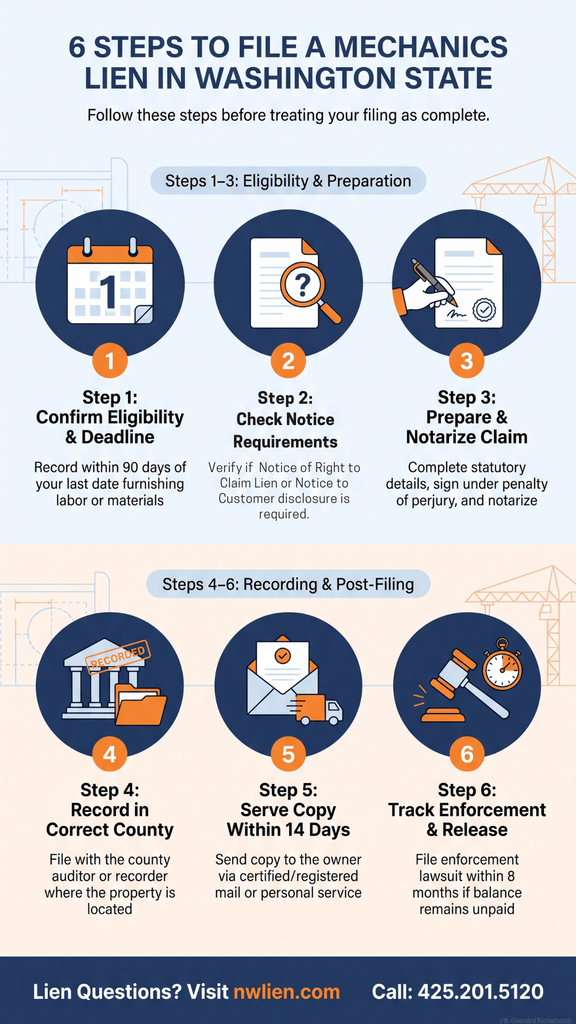
The mechanics lien process includes checking your rights, completing any required notices, preparing the claim, filing it for recording, notifying the owner, and tracking enforcement or release. Follow these steps before you consider your filing complete.
Step 1: Confirm Your Eligibility and Filing Deadline
Confirm that your unpaid claim concerns qualifying contributions to the property improvement. Review your contract, invoices, payment history, registration or licensing requirements, and the dates you last furnished work or supplies.
Washington generally requires you to file for recording no later than 90 days after you stop furnishing qualifying labor, professional services, materials, or equipment. Use your relevant furnishing date, not simply the invoice due date or the date the owner promised to pay.
Step 2: Check Your Notice and Disclosure Requirements
Determine whether your role and project require a Notice of Right to Claim Lien, a Notice to Customer disclosure, or other applicable notice. Review the notice section above rather than assuming every subcontractor or supplier follows the same rule.
LATE NOTICE?
If you did not send a required notice, seek guidance promptly. A late preliminary notice may still protect some qualifying furnishing, but it does not necessarily protect your entire unpaid balance. Existing owner-occupied remodels require particular attention.
Step 3: Prepare, Sign, and Notarize the Claim of Lien
Complete the Claim of Lien using the statutory checklist above. Before signing, verify the claimant, indebted party, property, owner information, furnishing dates, and principal amount.
The claimant or an authorized person must sign, affirm the claim under penalty of perjury, and complete the required acknowledgment. A notary can assist with the acknowledgment, but notarization does not establish that the claim is legally valid.
Step 4: File for Recording in the Correct County
File the completed document with the county auditor or recorder in the county where the property is located. Before submitting, check the office’s submission methods, formatting requirements, fees, and processing procedures.
Do not assume that mailing the document before your deadline means it has been timely filed for recording. Allow time for delivery, review, and correction of a rejected submission, and obtain confirmation from the recording office.
Step 5: Give the Owner a Copy Within 14 Days
Under RCW 60.04.091, give the owner or reputed owner a copy of the Claim of Lien by certified or registered mail, or by personal service, within 14 days after filing it for recording.
Keep evidence of the mailing or service. Failure to provide the copy within this period forfeits the claimant’s right to attorney fees and costs against the owner under RCW 60.04.181; it does not, by itself, invalidate the recorded lien.
Step 6: Track Payment, Enforcement, and Release
If the claim remains unpaid, the general deadline to file a lien-enforcement lawsuit is eight calendar months after recording. You must also serve the owner within 90 days after you file the lawsuit. Discuss enforcement with a Washington attorney before the deadline approaches. If you accept payment, release the lien.
Video Guide: Washington Mechanics Lien Filing
Prefer a video walkthrough? Watch our guide on how to file a contractor’s lien below.
Where Do You File a Washington Mechanics Lien?
File your Washington mechanics lien with the county auditor or recorder in the county where the property is located, not necessarily the county where your business is based.
For example, if your business is in Pierce County but the construction project is in King County, file the Claim of Lien with the King County Recorder’s Office.
Available submission methods vary by county. King County accepts documents in person, through a drop box, by mail, and through electronic recording arrangements. Check the King County Recorder’s official recording information for its current procedures.
File Your Lien Online
Prefer to stay focused on your projects? Northwest Lien has helped contractors and suppliers since 1999, and our lien specialists can handle the preparation, county recording, and certified mailing for you.
How Much Does It Cost to File a Lien in Washington State?
The cost of filing depends on whether you prepare the lien yourself, hire a lawyer, or use a filing service. DIY expenses may include county recording fees, notarization, and delivery.
Service pricing depends on what the provider includes.
As one county example, King County currently lists $303.50 for the first page in its “all other documents” category, plus $1 per additional page. Confirm the applicable category and current total with the recording office before submitting.
How much does it cost to file a lien with Northwest Lien?
For a flat fee of $529, our lien specialists handle document preparation, county recording, and certified mailing to the property owner.
Your price includes:
- Title search.
- Preparation of your Washington Claim of Lien.
- Online signing session with our in-house notary.
- County recording fees.
- Certified mailing to the property owner.
You provide the project details and review and sign the lien. We take care of preparing and filing your lien documents, so you can stay focused on your work.
Start Your Washington Lien OrderWhat Happens After You Record the Lien?
Recording makes your claim part of the public record, but it does not automatically transfer money to you or resolve a payment dispute. Track required delivery, payment communications, and the enforcement deadline.
A lien can complicate a sale or refinance, which may encourage the parties to address the claim. However, filing does not guarantee payment or categorically prevent every transaction.
Deadlines for Filing a Lien on Property in Washington
| Action | General Timing | Important Qualification |
|---|---|---|
| Provide required notices or disclosure | Depends on claimant role, project type, and the document required. | See the notice table above. Do not apply one notice deadline to every project. |
| File the Claim of Lien for recording | No later than 90 days after qualifying furnishing ends. | Use the claimant’s applicable furnishing date, not simply the invoice due date. |
| Give the owner a copy | Within 14 days after filing for recording. | Use certified or registered mail, or personal service. |
| File a lien-enforcement lawsuit | Generally within eight calendar months after recording. | RCW 60.04.141 contains provisions concerning stated credit terms and bankruptcy tolling. |
| Serve the owner with the enforcement lawsuit | Within 90 days after filing the action. | This is separate from sending the recorded lien copy. |
The general enforcement rule appears in RCW 60.04.141. Filing the claim with the county is not the same as filing a lawsuit in superior court. For more detail, read our guide to enforcing a mechanics lien in Washington.
What to do after you get paid?
Under RCW 60.04.071, after payment and acceptance of the amount due, the claimant must immediately prepare, execute, and deliver a release of the paid lien rights upon the owner’s or payer’s demand.
Arrange for the recorded claim to be appropriately released in the county records. If you receive only partial payment, make sure any release accurately reflects the rights being released rather than unintentionally releasing the remaining claim.
How to File a Washington Mechanics Lien With Northwest Lien
If you prefer help with preparation and county recording, Northwest Lien handles those steps from the project information you provide. You review and approve the document before signing, and we arrange recording and certified mailing to the property owner.
Our Filing Process
- Provide your project details, contract information, furnishing dates, and unpaid balance.
- We prepare your Washington Claim of Lien using the information you supply and the requirements of RCW 60.04.
- You review, approve, and sign the lien during an online signing session with our in-house notary.
- We file the document for recording with the appropriate county auditor or recorder.
- After recording, we send the lien copy to the property owner by certified mail within the required delivery period.
Tell us immediately if your recording deadline is approaching or if you are unsure which notices were sent. Preparing a lien document cannot restore a missed recording deadline or substitute for an earlier notice that the law required.
What Contractors Say About Northwest Lien
“I had a great experience working with Northwest Lien. I completed a full kitchen remodel for a homeowner with a signed contract in place, and the work was finished on time and passed inspection with no issues. When it came time to get paid, the owner refused and said they were selling the house instead.
I was referred to Northwest Lien by another contractor, and I’m really glad I found them. They took the time to walk me through my lien rights, explained my options clearly, and handled the filing process professionally from start to finish.
Within a week of filing the lien, I was paid in full.
If you’re a contractor dealing with a difficult payment situation, I can’t recommend Northwest Lien enough. They know exactly what they’re doing and make a stressful situation a lot easier to navigate. I’ll definitely be using them again if I ever need to.”
Brandon Emerson
This review describes one of our customers’ experiences. Filing a lien does not guarantee payment or a particular timeline.
Ready to move forward? Gather your project details, furnishing dates, contract information, and unpaid balance so we can begin preparing your Washington lien.
FAQs: Washington Mechanics Lien Filing
What are the requirements for filing a mechanic’s lien in Washington State?
You must have a qualifying construction claim, meet applicable notice and registration or licensing requirements, prepare and acknowledge a compliant Claim of Lien, and file it for recording in the correct county within the statutory period. You must also give the owner a copy within 14 days and track any enforcement deadline.
Can you file a lien without a lawyer?
Yes. Preparing and recording a Washington mechanics lien does not inherently require hiring a lawyer. You can work with online lien professionals like Northwest Lien to handle everything for you from start to finish. However, if you need to enforce the lien through a lawsuit, consult a Washington construction attorney.
Where can I find a Washington State mechanics lien form?
RCW 60.04.091 contains the required information and a sample Claim of Lien. Northwest Lien does not currently offer a downloadable blank Claim of Lien form. Our cheat sheet explains the process and deadlines; if you use our filing service, we prepare the lien document from your project details.
Can I file a Washington mechanics lien online?
Electronic recording is available through participating county offices and approved submission arrangements. It is not one statewide filing process with identical access rules. Check the county where the property is located or use a filing service that handles the county submission. Our mechanics lien process is simple and reliable. Reach out today.
Can I still file if I did not send a preliminary notice?
Possibly. Some claimants are exempt, while others need notice to preserve an enforceable claim. A late notice may protect some qualifying furnishing under the applicable lookback rule. Existing owner-occupied remodels have a separate limitation tied to amounts the owner has not yet paid the prime contractor. Check your role and project before assuming all rights are lost or fully protected.
Does county recording mean my lien is legally valid?
No. Acceptance for recording does not establish that your claim is legally enforceable. For example, King County explains that its staff check formatting, legibility, indexing information, and fees, but cannot determine a document’s legal correctness. Eligibility and notice compliance remain separate issues.
How long does a mechanics lien last in Washington State?
Generally, a Washington mechanics lien binds the property for eight calendar months after recording unless a timely enforcement action is filed and the owner is served within 90 days after that filing. RCW 60.04.141 contains additional provisions concerning stated credit terms and bankruptcy tolling, so unusual circumstances require legal review.
If my lien expires, can I still collect the unpaid debt?
Losing the ability to enforce a lien does not necessarily erase the underlying debt or every collection remedy. RCW 60.04.191 preserves personal actions to recover qualifying debts. An attorney can assess the remaining claims and their separate deadlines.
Washington Lien Laws and Related Guides
Primary Legal Sources
- RCW 60.04.021: Authorized lien claims.
- RCW 60.04.031: Notices and exceptions.
- RCW 18.27.114: Contractor disclosure requirements.
- RCW 60.04.091: Recording deadlines and claim contents.
- RCW 60.04.141: Enforcement deadlines.
- RCW 60.04.071: Release of paid lien rights.
- RCW 60.04.191: Personal actions to recover debts.
Related Northwest Lien Guides
- Washington mechanics lien deadlines
- Washington Notice of Intent to Lien
- How to enforce a mechanics lien in Washington
- Common mistakes when filing a mechanics lien
Disclaimer: This article provides general information about Washington mechanics liens and is not legal advice. Eligibility, notice requirements, deadlines, and enforcement depend on the facts of your project. Consult a qualified Washington attorney for advice about your specific claim.