How To Become A General Contractor In California: Requirements & Guide
by Michelle McCullum

Quick Summary: How to Become a General Contractor in California
To get a general contractor license in California, you must meet specific age and experience requirements, apply through the CSLB, and pass two state exams. The entire process generally takes between three to six months and costs around $650 in state fees.
- Step 1 – Check Qualifications: You must be at least 18 years old and provide proof of 4 years of journey-level experience within the last 10 years.
- Step 2 – Apply to CSLB: Submit your application with a $450 fee to the Contractors State License Board (CSLB) and complete a Live Scan fingerprint background check.
- Step 3 – Pass the Exams and Bond: Pass the required Law/Business and Trade exams, pay the $200 initial license fee, and file a $25,000 contractor’s bond to activate your license.
Note: Working without an active license in California can result in severe penalties. Once licensed, you can protect your project payments and cash flow by filing a mechanics lien in California if a client fails to pay. Reviewed for accuracy by lien specialists. Updated June 2026.
In this article:
- Quick Summary: How to Become a General Contractor in California
- What is a General Contractor in California?
- Requirements to Become a General Contractor in California
- Step-by-Step Guide: How to Get a General Contractor License
- Benefits of Getting a General Contractor License in California
- Protect Your Construction Business
- Why Trust Northwest Lien Service
- Helpful Resources
- Key Takeaways: Becoming a California General Contractor
- FAQs: California General Contractor License
What is a General Contractor in California?
In California, a general contractor (GC) is a licensed expert responsible for managing construction, remodeling, or repair projects. They serve as the primary point of accountability, overseeing the entire project and coordinating specialized trades such as plumbing and electrical to ensure timely completion and compliance with building codes.
The California Contractors State License Board (CSLB) requires anyone charging $500 or more for materials and labor to hold a valid license. Operating without an active license can result in steep penalties and may render your business contracts unenforceable.
Class A vs. Class B vs. Class C Licenses
California issues different contractor classifications depending on the specific scope of your construction work.
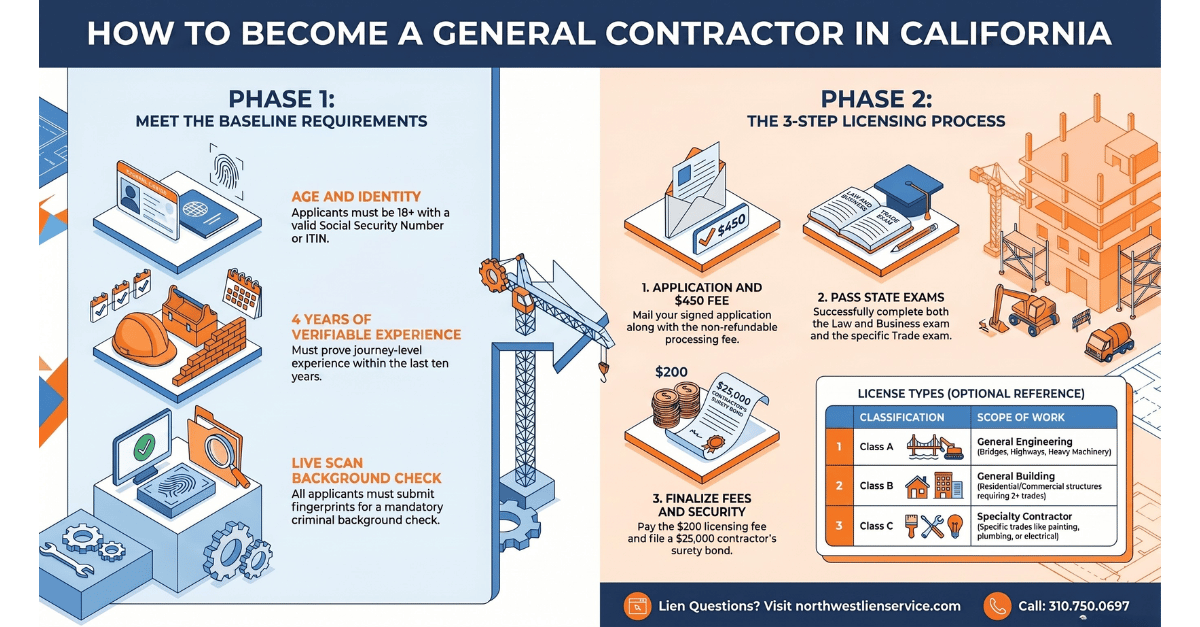
- Class A General Engineering Contractor: Covers specialized engineering projects like bridges, dams, and highways. Class A contractor license requirements typically include specific civil engineering knowledge and experience with heavy machinery.
- Class B General Building Contractor: Covers structures built for shelter that require at least two unrelated building trades. This is the standard classification for residential and commercial builders.
- Class C Specialty Contractor: Covers specific individual trades. To get a painting license in California, or do specialized plumbing and electrical work, you would apply for a Class C classification.
Requirements to Become a General Contractor in California
To meet the requirements for a general contractor in California, you must satisfy three baseline qualifications established by the Contractors State License Board (CSLB). These include meeting age limits, proving hands-on trade experience, and passing a mandatory background check.
- Age and Identity Requirements: You must be at least 18 years old to apply. You must also hold a valid Social Security number (SSN) or Individual Taxpayer Identification Number (ITIN).
- Four Years of Verifiable Experience: You must prove exactly four full years of journey-level experience within the last ten years. This work history must be documented on paper and signed by a qualified verifier, such as a former employer, union representative, or another licensed contractor.
- Live Scan Background Check: All applicants must submit fingerprints for a Live Scan criminal background check. While having a prior criminal conviction could delay your application review, it typically does not automatically disqualify you from getting a license.
Step-by-Step Guide: How to Get a General Contractor License
Follow the exact procedure set by the CSLB below to helps avoid costly delays in getting your business up and running.
Step 1: Complete the Application
To become a general contractor in California online, you must fill out the Application for Original Contractor License. While you can access and fill out the official forms on the CSLB website, you typically must mail the final application packet with your wet signature.
Step 2: Pay the Application Fee
Include the non-refundable $450 application fee with your paperwork. Check out the List of All CSLB Fees to determine the total fees due.
Step 3: Pass the CSLB Exams
Once the state approves your application, you will receive a testing date for the Law and Business exam and the Trade exam. Reviewing general B contractor license test questions through authorized study guides can help you prepare for the specific trade knowledge required to pass.
Step 4: Pay the Initial License Fee
After passing your exams, you must pay a $200 initial licensing fee to the state.
Step 5: File a Contractor’s Bond
You must purchase and file a $25,000 surety bond with the CSLB before your license becomes active. This bond protects consumers and employees if a contractor fails to follow state regulations.
Step 6: Obtain Required Insurance
If you plan to hire employees, you must secure workers’ compensation insurance and file the certificate with the CSLB.
Infographics Guide: Requirements & Steps to be a GC in California
Save our simple infographics guide to understand the key requirements and steps to get a GC license in CA.
Benefits of Getting a General Contractor License in California
The main benefits of getting a general contractor license in California include the legal ability to take on projects over $500, increased credibility with clients, and the right to secure your project payments through a mechanics lien. Operating a recognized construction business offers several major advantages:
- Legal Bidding on Larger Projects: California law generally limits unlicensed builders to small handyperson jobs under $500, which includes both labor and materials. An active license removes this cap, allowing you to bid on highly profitable residential and commercial contracts.
- Get Your Payment Protected with Mechanics Liens: Unlicensed contractors generally lose their right to enforce construction contracts. Holding a valid CSLB license protects your right to file a mechanics lien, allowing you to seek compensation against the property if a client fails to pay you.
- Client Trust and Credibility: Property owners, developers, and lenders actively check state records before hiring. Holding a license proves you have met the state’s experience requirements, passed the necessary trade exams, and carry a valid surety bond.
- Business Growth and Permits: Only licensed contractors can legally pull building permits in most California jurisdictions. A valid license also allows you to hire subcontractors, establish your business entity, and compete for specialized government or commercial jobs.
Protect Your Construction Business
Once licensed, protecting your project cash flow is critical to running a successful contracting business. Northwest Lien helps contractors manage preliminary notices and mechanics liens to protect their right to payment on their construction jobs. Sending a preliminary notice at the start of a project generally secures your ability to file a claim later if a client fails to pay their invoices. Contact our team today to streamline your notice paperwork and focus on building.
Why Trust Northwest Lien Service
Northwest Lien has been helping contractors, subcontractors, and industry professionals protect their payment since 1999. We have collected over $250 million for our clients through mechanics liens, construction liens, notices, and other lien services over the years.
“I was referred to Northwest Lien by another contractor, and I’m really glad I found them. They took the time to walk me through my lien rights, explained my options clearly, and handled the filing process professionally from start to finish. Within a week of filing the lien, I was paid in full.”
Brandon Emerson
Helpful Resources
- Mechanics Lien California: Requirements, Deadlines & How to File
- Requirements For Obtaining A Specialty Contractor License In California
FAQs: California General Contractor License
How much does it cost to become a general contractor in California?
The total estimated initial state fees amount to around $753 for a single-owner business. This essential breakdown covers the required CSLB filing steps:
- Application Fee: $450 (Non-refundable)
- Initial License Fee: $200 (For a sole owner)
- Exam Fee: $103 (Around $51.50 per exam)
Note: You must also account for third-party costs, such as Live Scan fingerprinting and the annual premium for your mandatory $25,000 surety bond.
How long does it take to become a general contractor in California?
The timeline is generally 3-6 months. Processing times vary by season, but completing your paperwork accurately, quickly resolving any background check issues, and scheduling your exams promptly helps avoid unnecessary delays.
How to get a general contractor license without experience?
You cannot hold your own active license without meeting the state’s experience criteria. If you lack the required four years, you can partner with a qualifying individual who possesses the necessary experience to act as the Responsible Managing Employee (RME) or Officer (RMO) for your business entity.
Is it worth it to be your own GC?
Acting as an owner-builder on your own home project can save you money, but it also means taking on immense legal and financial responsibility. You must pull the permits, ensure compliance with building codes, and maintain job site safety.
| Pros of Being Your Own GC | Cons of Being Your Own GC |
|---|---|
| You save 15% to 25% on the markup typically charged by professional GCs. | You are legally liable for any injuries, accidents, or code violations on the job site. |
| You retain total creative and financial control over the project timeline. | You must manage complex subcontractor schedules, material delays, and payroll taxes. |
What are the General B contractor license test questions?
The California General B exam is entirely closed-book and consists of two parts. You must pass both sections with a score of 72% or better. You can check out online sample quizzes for questions.
- Law and Business Exam: Covers business organization, employment requirements, contracts, public works, and mechanics liens.
- Trade Exam: Tests your practical knowledge of estimating, framing, core trades (like plumbing and electrical), finish trades, and job site safety.
Is it hard to get a general contractor license in California?
The process is considered strict. The main difficulty lies in properly documenting the required four years of verifiable journey-level experience and passing the comprehensive, closed-book state exams. However, thorough preparation using authorized study guides makes the testing process highly manageable for most construction professionals.
Disclaimer: This article is for informational purposes only and does not constitute legal advice. For specific legal guidance regarding your situation, please consult with a qualified local attorney.
Ready with your first project as a licensed GC? Start protecting your payment rights.