
How to Send a California 20-day Preliminary Notice: Complete Guide
by Krista Lerma

Quick Summary: How to Send a California 20-Day Preliminary Notice
A California 20-Day Preliminary Notice is a required written notice that subcontractors, suppliers, and equipment lessors must serve within 20 days of first furnishing labor or materials to preserve their right to file a mechanics lien. If a preliminary notice was required and you do not serve it on time, your lien rights for some or all of the work may be limited.
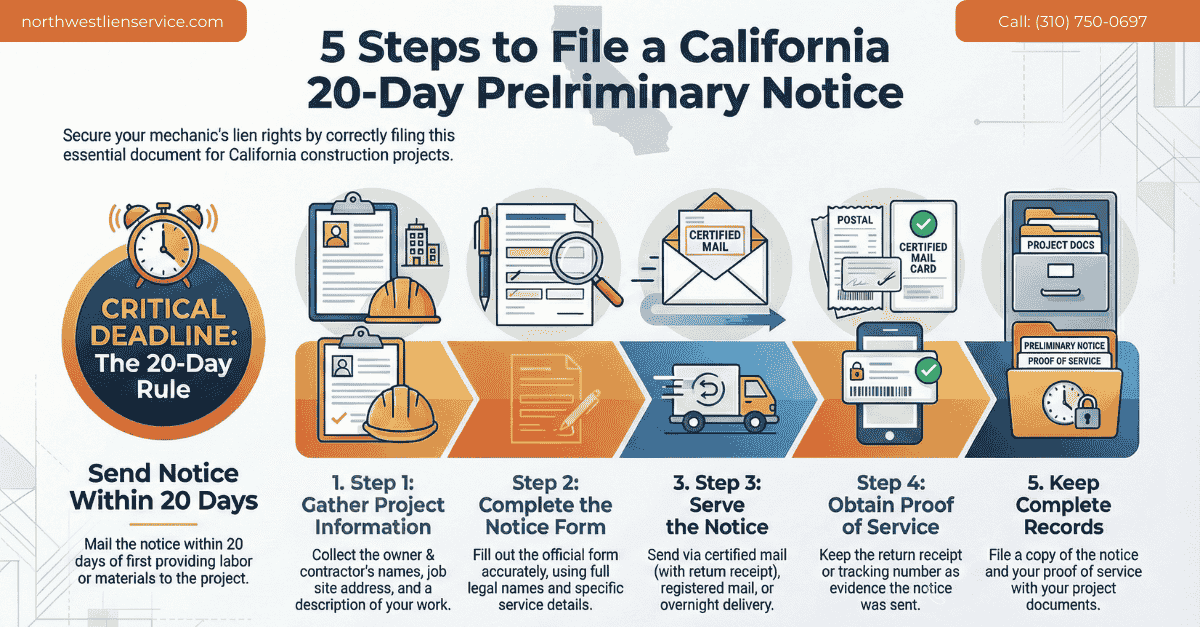
- Step 1 — Gather Information: Collect the property owner’s name, general contractor’s name, job site address, a description of your work or materials, and the name of any construction lender.
- Step 2 — Complete the Form: Complete all required fields and verify the project information before serving the notice. Include the required California Civil Code warning language.
- Step 3 — Serve the Notice: Deliver via certified mail, registered mail, express mail, or overnight delivery to the property owner, general contractor, and construction lender (if applicable).
- Step 4 — Obtain Proof of Service: Keep the return receipt or mailing confirmation. The deadline is met when you mail the notice, not when it is received.
- Step 5 — Keep Records: Retain copies of the notice and all proof of service in case of a future payment dispute or lien filing.
Late Filing Warning: If you miss the 20-day window, a late notice still protects work performed in the 20 days before it was sent and all work afterward — but anything furnished earlier receives no lien protection. Read our full guide below, reviewed for accuracy by our lien specialists. Updated September 2026.
Sounds overwhelming? We can help.
Video Guide: California 20-day Preliminary Notice Explained in 2 Minutes
Learn how to send a 20-day Preliminary Notice to protect your payment rights in less than 2 minutes.
What is a 20-day preliminary notice in California?
A California 20-day preliminary notice is a required communication that informs property owners, general contractors, and construction lenders that you are providing work or materials on their project. Under California Civil Code, you generally must serve this notice if you do not have a direct contract with the property owner.
A standard notice typically includes:
- Your business information and role on the project
- A general description of the labor or materials provided
- The job site address
- The estimated total price of your work
Step-by-Step Guide: How to Send a Preliminary Notice in California
To send a California 20-day preliminary notice, first verify the project parties and your first-furnishing date, then complete the notice, serve it using an allowed delivery method, and retain proof of service. The process is deadline-driven, so begin gathering project information as soon as you start furnishing labor, services, equipment, or materials:
Step 1: Confirm your deadlines.
Your 20-day period generally begins when you first furnish labor, services, equipment, or materials for the project—not when you send an invoice or discover a payment problem. Record that first date immediately so your office has a clear deadline.
Before preparing the notice, confirm:
- The first date your crew performed work at the jobsite
- The first date materials or equipment were delivered or furnished
- Whether preconstruction services or design work may affect the timing
- Whether anyone on your team began work before the date shown on the first invoice
- The date you plan to serve the notice
Practical tip: Do not wait until payment is late. The most reliable workflow is to open a preliminary-notice task when you’re awarded a new California project or when you schedule your first delivery.
Step 2: Identify the correct project parties.
A California preliminary notice must identify the right parties connected to the project. Do not rely only on an informal job sheet, text message, or the name your customer uses in conversation.
Gather and verify:
- The property owner or reputed owner
- The direct contractor, also called the general contractor in many projects
- The construction lender, if one is known
- The complete jobsite address, including unit, building, lot, or phase details when applicable
- Your customer’s correct business name and role in the project
Confirm the project address and party names match across your contract, purchase order, invoices, and any available property or project records. A name or address mismatch can create problems later, especially on large developments, tenant improvements, multi-building sites, or projects with several related entities.
| Your Role | Serve Owner or Reputed Owner? | Serve Direct Contractor? | Serve Construction Lender? |
|---|---|---|---|
| Direct contractor | Generally not required when you have a direct contract with the owner | Not applicable | Yes, if there is a construction lender or reputed construction lender |
| Subcontractor | Yes | Yes | Yes, if there is a construction lender or reputed construction lender |
| Material supplier or equipment lessor | Yes | Yes | Yes, if there is a construction lender or reputed construction lender |
| Laborer | Generally not required | Generally not required | Generally not required |
Important: Recipient requirements can depend on your contract relationship, project facts, and whether a construction lender is involved. This table is a general guide based on California Civil Code § 8200; consult qualified California counsel for guidance on a specific project.
Step 3: Complete the California preliminary-notice form.
The notice should clearly identify who you are, what you are furnishing, and where the work is taking place. Complete the required form information carefully and use a general, accurate description of your labor, services, equipment, or materials.
A typical California preliminary notice includes:
- Your business name, address, and contact information
- Your role on the project, such as subcontractor, material supplier, equipment lessor, or design professional
- The owner or reputed owner
- The direct contractor
- The construction lender, if applicable
- The project location
- A general description of the work, services, equipment, or materials furnished
- The estimated total price of your work or materials
- The required California warning language
Use consistent information throughout the notice. For example, the business name on the notice should match the name used in your contract or purchase order whenever possible. If your company operates under a DBA, confirm which name should appear before service
Step 4: Serve the notice on every required recipient.
Once the notice is complete, serve it on the appropriate parties using an accepted delivery method. In California, service is generally completed by personal delivery, registered or certified mail, express mail, or overnight delivery by an express service carrier. California Civil Code § 8110 addresses service methods for preliminary notices.
The people or entities who may need to receive the notice include:
- The property owner or reputed owner
- The direct contractor
- The construction lender, if applicable
Send the notice to each required recipient separately and use the correct mailing address for that party. A notice sent only to the general contractor, or sent to an incomplete or incorrect address, may not provide the protection you expect.
Important: A California preliminary notice is served; it is not the same thing as recording a mechanics lien with the county recorder.
Step 5: Save proof of service and maintain a project deadline file.
After serving the notice, keep copies of the completed notice and documents showing when and how you sent it. Your file should make it easy to confirm the service date, recipients, delivery method, and tracking information if a payment issue develops later.
Keep:
- A copy of the completed preliminary notice
- Mailing receipts, tracking records, or other proof of service
- The date each recipient was served
- The project contract, purchase order, invoices, and change orders
- Payment communications and account records
- Your first-furnishing date and any later lien-related deadlines
A preliminary notice does not automatically create a mechanics lien. It is an early notice that can help preserve the option to record a lien later if payment remains unresolved.
Can you file a mechanics lien in California without a preliminary notice?
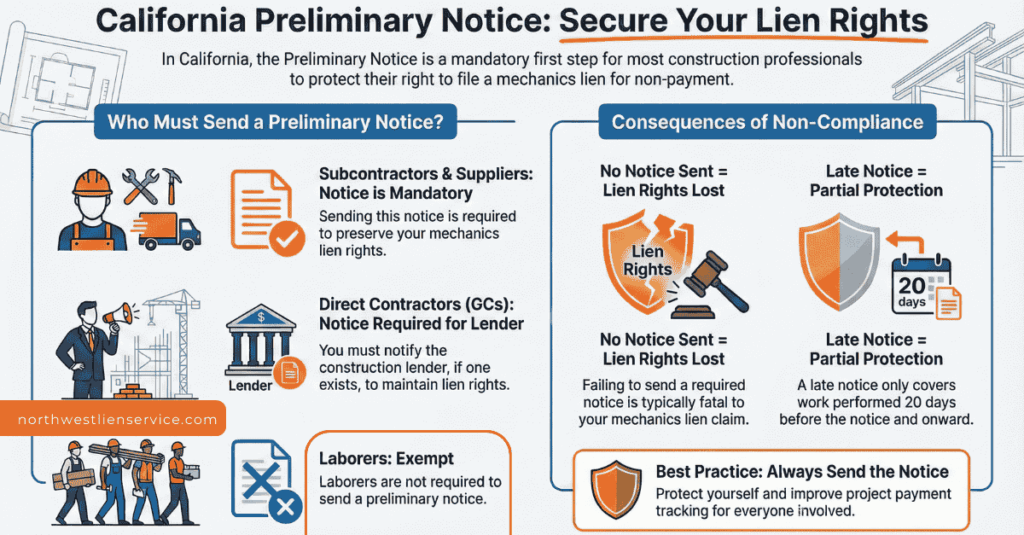
No, subcontractors and material suppliers generally cannot file a valid mechanics lien in California without first serving a preliminary notice. Serving this notice is a mandatory step to protect your payment rights on construction projects.
Parties required to send this notice include:
Read more: Can You File a Lien Without a Prelim Notice
What mistakes should I avoid when sending a California preliminary notice?
Northwest Lien Insight: One issue our team regularly sees is contractors waiting until an invoice is overdue before starting the notice process. By that point, the first-furnishing date may be weeks in the past. We recommend creating a preliminary-notice task when a California job is awarded or when the first delivery is scheduled; not when payment becomes a concern.
What should I do after serving a California preliminary notice?
Document Everything
- Record the date you mailed your notice along with all tracking information.
- File your proof of service with other project records.
- Document all payment terms and contractor communications related to the specific job.
Track Important Deadlines
Mark these dates on your calendar:
- First day you worked or delivered materials
- Date you mailed your preliminary notice
- Final payment due date
- Mechanics lien filing deadline
Respond to Errors Quickly
If you discover incorrect or missing information in your notice, correct it immediately by sending an amended notice with accurate details. The sooner you fix errors, the better your payment protection will be.
When is the deadline to send a California preliminary notice?
Send your preliminary notice within 20 days of first furnishing labor, materials, services, or equipment to the project. The requirement is met when the notice is mailed, not when it’s received, so proof of mailing suffices.
What Happens If You Send It Late?
Late notices still provide protection, but only for the value of labor or materials provided in the 20 days before sending the notice and anything provided afterward. Work performed before that 20-day window receives no lien protection.
Best Practice Timing
Start gathering project information early so you can serve the notice promptly after first furnishing. Early filing ensures compliance and eliminates the stress of tracking deadlines while juggling project demands.
How does a California preliminary notice affect mechanics lien rights?
Mechanics Lien Foundation
A properly filed preliminary notice creates the legal foundation to file a mechanics lien if you’re not paid. If a preliminary notice was required but was not served, your ability to enforce a mechanics lien may be limited. A late notice may still protect qualifying work furnished during the 20 days before service and work furnished afterward.
Project Visibility
The notice alerts all parties to your involvement and sets clear payment expectations. It demonstrates your knowledge of California construction law and your commitment to protecting your rights.
Early Warning System
Sending notices establishes a paper trail that helps resolve payment disputes before they escalate. Property owners and general contractors take payment obligations more seriously when they know you’ve preserved your lien rights.
When should I use a California preliminary-notice service?
A California preliminary-notice service can be useful when your team is managing multiple projects, needs help verifying project-party information, or wants support preparing, serving, and tracking notices. The goal is to reduce administrative workload while keeping project records and service documentation organized.
Download our Cheat Sheet with our Lien Filing Process.
How can Northwest Lien help send a California preliminary notice?
Northwest Lien helps contractors and suppliers prepare and serve California preliminary notices without managing every research, paperwork, mailing, and proof-of-service step internally. Our team has supported construction-payment filings since 1999 and offers California preliminary notices for a flat fee of $45.
“NW Lien has assisted our company with several claims, and they have all ended with us getting paid. Their customer service is great, informative, and they have made the process very easy. [They] always deliver top-notch customer service, they are amazing to work with, and I highly recommend working with them.”
Cassie Endicott
FAQs: California 20-Day Preliminary Notice
Do I need to send a preliminary notice on every California construction project?
Yes. Most parties without a direct contract with the property owner must send a preliminary notice (prelim) to preserve mechanics lien rights. This typically includes subcontractors, suppliers, and equipment rental companies. Direct contractors generally don’t send one to the owner, but may need to notify the construction lender when applicable.
What happens if I never send a preliminary notice?
If you were required to serve one and didn’t, you can lose your right to file a mechanics lien. You may still have other options to pursue payment (like a contract claim), but the lien remedy may be off the table.
Are there any parties not required to serve a preliminary notice in California?
Some parties may be exempt depending on their role and contract relationship. Common examples include direct contractors (who generally don’t serve a notice to the owner) and individuals who only perform labor.
How long do I have to file a mechanics lien after sending a preliminary notice?
The lien deadlines depend on the project’s status and whether a Notice of Completion (or similar notice) is recorded. Because the timing rules can vary for general contractors vs. subs/suppliers, it’s best to confirm deadlines for your specific project before recording.
What is the difference between a preliminary notice and a mechanics lien?
A preliminary notice is an early project notice that helps preserve your right to file a lien later. A mechanics lien is the actual legal claim recorded against the property if you remain unpaid.
How to fill out a California preliminary notice?
In general, you’ll enter your business details, the job site address, the owner/GC (and lender, if applicable), a brief description of labor/materials, and the required warning language. Talk to our California lien specialists for a walkthrough.
How much does it cost to file a preliminary notice in California?
Costs vary based on how you prepare and serve it. At minimum, expect delivery/postage costs; if you use a professional service, fees can include document prep, mailing, and tracking/proof of service. Northwest Lien offers an affordable flat-fee $45 preliminary notice.
Disclaimer: This article is for informational purposes only and does not constitute legal advice. Mechanics lien laws are complex and vary by jurisdiction. For specific legal guidance regarding your situation, please consult with a qualified attorney licensed in California.