How to File a Mechanics Lien in California: 5 Steps
by Michelle McCullum

Quick Summary: How to File a Mechanics Lien in California
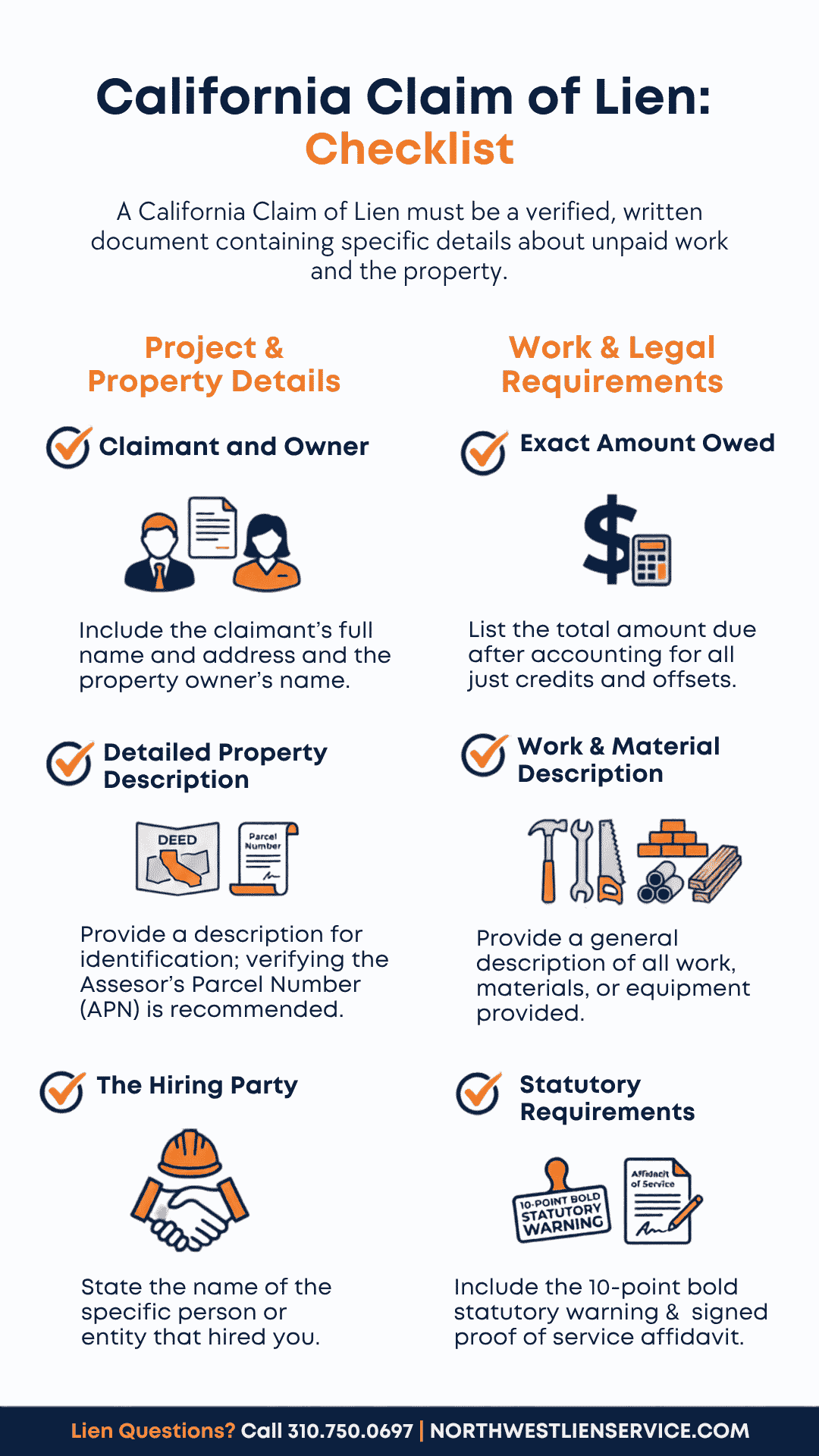
Filing a California mechanics lien generally involves five steps:
- Serve a Preliminary 20-Day Notice, if required.
- Prepare a verified Claim of Lien.
- Serve the Claim of Lien on the owner.
- Record the Claim of Lien before the applicable deadline.
- File a foreclosure lawsuit within 90 days after recording, if payment remains unresolved.
The filing deadline is generally 90 days after completion, but a recorded Notice of Completion or Notice of Cessation can shorten it. See the full step-by-step guide and deadline table below. Updated July 2026.
Sounds overwhelming? We can help.
In this article:
- Quick Answer: How to File a Mechanics Lien in California
- Step-by-Step Guide: How to File a Mechanics Lien in California
- Checklist: What Information Must Be Included?
- Timeline Summary: California Mechanics Lien Deadlines
- How much does it cost to file a mechanics lien in California?
- Who can file a mechanics lien in California?
- What is a mechanics lien in California?
- DIY vs. Professional Lien Service
- Why Work with Northwest Lien
- California Mechanics Lien FAQs
Step-by-Step: How to Record a Mechanics Lien in California
To file a mechanics lien in California, follow these five steps:
- Serve a Preliminary 20-Day Notice, if required. Most subcontractors, suppliers, and equipment lessors should serve notice on the owner, direct contractor, and construction lender, if any, within 20 days after first furnishing labor, services, equipment, or materials. (California Civil Code §§ 8200 and 8204)
Learn how to send a preliminary notice in California with our step-by-step guide
- Prepare the Claim of Lien. Complete a verified Claim of Lien that identifies the claimant, amount owed, owner or reputed owner, hiring party, work provided, and property.
- Serve the Claim of Lien on the owner. Send a copy of the completed lien to the property owner no later than the time you record it, and complete the required proof of service affidavit. (California Civil Code § 8416)
- Record the Claim of Lien. Record the verified lien and proof of service with the county recorder where the property is located. The deadline is generally 90 days after project completion, but it may shorten to 30 or 60 days after a valid Notice of Completion or Notice of Cessation. (California Civil Code §§ 8412–8414)
- Enforce the lien, if necessary. If you are still unpaid, file a foreclosure lawsuit within 90 days after recording the lien. If you miss this deadline, the lien becomes unenforceable. (California Civil Code § 8460)
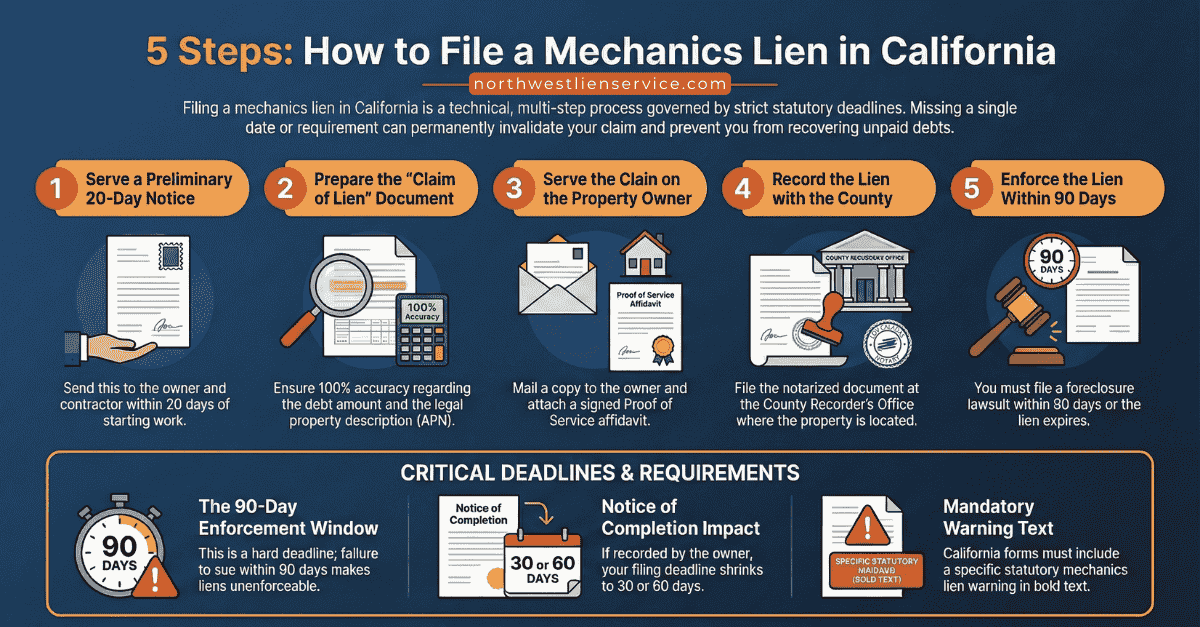
Checklist: What is required to file a mechanic’s lien in California?
A California Claim of Lien must be a verified written document that contains specific details about the unpaid work and the property. Missing any of these statutory requirements can invalidate your claim entirely.
You must include:
- The claimant’s name and address.
- The exact amount owed after all just credits and offsets.
- The name of the property owner or reputed owner.
- The name of the party who hired you.
- A general description of the work, materials, or equipment you provided.
- A description of the property sufficient for identification (verifying the Assessor’s Parcel Number is highly recommended).
- The required statutory warning notice in bold, 10-point type.
- A signed proof of service affidavit.
Timeline Summary: California Mechanics Lien Deadlines
Track these key dates and time limits to avoid missing any deadlines (California Civil Code 8412).
| Deadline | Key Details |
|---|---|
| 1. Serve Preliminary Notice | Most subcontractors, suppliers, and equipment lessors should serve a Preliminary 20-Day Notice within 20 days of first providing labor, services, equipment, or materials, sent to the owner, direct contractor, and construction lender, if any. |
| 2. Record (after a Notice of Completion or Cessation) | Record the Claim of Lien within 60 days after a valid Notice of Completion or Notice of Cessation is recorded if you are a direct contractor. Other claimants generally have 30 days. |
| 3. Record (if No Notice Is Recorded) | If no valid Notice of Completion or Notice of Cessation is recorded, record the Claim of Lien within 90 days after completion of the entire work of improvement. |
| 4. Enforce the Lien | File a lawsuit to enforce the lien within 90 days after recording the Claim of Lien. If you miss this deadline, the lien becomes unenforceable. |
Read our full guide: California lien deadlines →
How much does it cost to file a mechanics lien in California?
Filing a mechanics lien in California typically costs about $100 to $500, depending on the county, document length, mailing method, property research needs, and whether you use a filing service. County recording fees and local requirements vary, so confirm the current fee schedule with the recorder in the county where the property is located.
Your total cost will include:
- County Recording Fees: Usually $20 to $95 for the first page, plus $3 per additional page.
- Statutory Fees: Many counties add a $75 state-mandated Building Homes and Jobs Act fee.
- Service Fees: $10 to $30 for Certified Mail with return receipt.
- Filing Services (Optional): Professional preparation and recording through Northwest Lien Service offers flat-rate pricing to ensure compliance.
Check Rates
Fee examples are estimates only and were last reviewed July 2026. Check the applicable county recorder for current fees.
Who can file a mechanics lien in California?
A person or business that furnishes authorized labor, services, equipment, or materials for a private California work of improvement may have mechanics lien rights if statutory requirements are met. Eligibility depends on the claimant’s role, applicable licensing requirements, the work furnished, and compliance with notice and recording rules. Here’s a breakdown of who is eligible under California Civil Code §§ 8400–8410:
- Direct Contractor (General Contractor)
- Subcontractor
- Material Supplier
- Equipment Lessor
- Laborer, handyman
- Licensed design professionals (architects, engineers, surveyors)
What is a mechanics lien in California?
A mechanics lien form in California is a legal claim filed against a property by a licensed contractor or supplier to recover unpaid funds for labor or materials. This recorded claim places a hold on the property title.
- Provides powerful leverage to recover unpaid invoices.
- Prevents the property owner from easily selling or refinancing the property.
- Is a constitutionally protected right in California (Cal. Const., art. XIV, Section 3).
DIY vs. Professional Lien Service
A DIY mechanics lien may seem like the lower-cost option at first. But one missed deadline, incorrect property detail, service error, or unsupported claim can cost far more than the filing itself and may create avoidable legal exposure. Northwest Lien Service helps you move forward with a clear, deadline-focused filing process.
| Feature | Do It Yourself (DIY) | Northwest Lien Service |
|---|---|---|
| Property Owner Verification | ❌ High Risk. You rely on the contract or tax bill, which may not list the legal owner of record. | ✔FREE Title Search Included. We verify the actual property owner through official county records. |
| Legal Description (APN) | Manual Search. Using just a street address can invalidate your lien. Finding the APN is difficult. | ✔Verified. We locate the exact description required by California law. |
| Forms & Compliance | Outdated? Generic forms found online may miss recent California legislative changes (like the 2011 overhaul). | ✔Guaranteed. Our forms are reviewed by experts to ensure compliance with current statutes. |
| Filing Process | Time-consuming. Driving to the recorder’s office, standing in line, or mailing and hoping it arrives. | ✔Fast & Electronic. We use E-Recording in most counties. We offer rush lien filing when applicable. |
| Liability Risk | ⚠️ High. A clerical error may result in a “Slander of Title” lawsuit against you. | ✔Protected. We file with accuracy, so you avoid frivolous counterclaims. |
Why Work with Northwest Lien
We’ve helped thousands of contractors and suppliers file mechanics liens in California, Oregon, and Washington since 1999. We make lien filing fast, accurate, and stress-free.
“NW Lien has assisted our company with several claims, and they have all ended with us getting paid. Their customer service is great, informative, and they have made the process very easy. [They] always deliver top-notch customer service, they are amazing to work with, and I highly recommend working with them.”
Cassie Endicott
Our Lien Filing Process
Oops! We could not locate your form.
Do I need a lawyer to file a mechanics lien in California?
No, you don’t need a lawyer to prepare and record a mechanics lien in California, but you will likely need one if you must file a lawsuit to enforce it. Many contractors use a professional lien service, such as Northwest Lien, to handle the complex paperwork and meet recording deadlines.
- Recording the Lien: Can be done yourself or through a professional service.
- Enforcing the Lien: Requires filing a foreclosure lawsuit in civil court within 90 days, which generally requires a California construction attorney.
FAQs: California Mechanics Lien
Can I file a mechanics lien without a written contract in California?
Yes, a written contract is not always required. Subcontractors and suppliers may have lien rights if they furnished authorized labor, services, equipment, or materials to a private project. However, without a written agreement, it can be harder to prove the scope of work, amount owed, and payment terms.
Can you file a mechanics lien without a preliminary notice in California?
Generally, no. Most subcontractors, suppliers, and equipment lessors must serve a Preliminary 20-Day Notice before recording a California mechanics lien. Laborers are generally exempt, and a direct contractor typically gives notice only to the construction lender, if any. If notice is served late, it generally protects only work furnished during the 20 days before service and afterward. Watch our quick guide →
Is a Notice of Commencement required in California?
No. California does not use a Notice of Commencement for private construction projects. Instead, claimants should focus on serving a Preliminary 20-Day Notice, if required, and watching for a Notice of Completion or Notice of Cessation, which can shorten the lien-recording deadline.
How long do you have to file a mechanics lien in California?
If no valid Notice of Completion or Notice of Cessation is recorded, claimants generally have 90 days after completion of the work of improvement to record a Claim of Lien. If one is recorded, the deadline is shorter: 60 days for direct contractors and 30 days for subcontractors, suppliers, and other claimants.
Can you file a mechanics lien after 90 days in California?
Usually, no. If no Notice of Completion or Notice of Cessation was recorded, you generally must record the lien within 90 days after completion of the work of improvement. If a valid notice was recorded, the deadline may be only 30 or 60 days. A late-recorded lien is generally unenforceable.
What makes a mechanics lien invalid in California?
A California mechanics lien may be invalid or unenforceable if the claimant misses a required notice, records after the deadline, names the wrong owner, uses an insufficient property description, claims an improper amount, fails to include required lien information or proof of service, or lacks a required contractor license.
Can an unlicensed contractor file a mechanics lien in California?
Generally, no. Unlicensed contractors are barred from using the mechanics lien process to recover compensation if the work they performed required a license. Laborers and material suppliers may have different rules.
Does a mechanic’s lien need to be notarized in California?
No, the Claim of Lien itself does not need to be notarized. California law requires the claim to be signed and verified, and a properly verified claim must be accepted for recording without a notary acknowledgment. However, a Release of Mechanics Lien may require notarization before it can be recorded. Always confirm the current document requirements with the recorder in the county where the property is located.
How do I release a mechanics lien after payment?
After receiving payment or resolving the claim, record a Release of Mechanics Lien with the county recorder where the original lien was recorded. Recording the release clears the recorded lien from the property title.
Who do mechanics liens benefit the most?
Mechanics liens benefit subcontractors, suppliers, equipment lessors, and laborers—lower-tier project participants who lack direct contracts with the owner. A lien allows them to bypass the contractor and claim directly against the owner’s property, ensuring payment if the contractor defaults.
Helpful Sources
- How to File a Mechanics Lien in Los Angeles County
- Avoid Mechanics Lien Mistakes in California
- California Liens Resource Page: All You Need to Know
- Watch: What is the Penalty for Filing a False Mechanics Lien in California?
Disclaimer: This article is for informational purposes only and does not constitute legal advice. Mechanics lien laws are complex and vary by jurisdiction. For specific legal guidance regarding your situation, please consult a qualified California-licensed attorney.