Washington Notice to Owner: How to Submit a Model Disclosure Statement in Washington State
by Krystal Samarin

Quick Summary: Washington Model Disclosure Statement
In Washington State, a Model Disclosure Statement (RCW 18.27.114) is a notice requirement specifically for prime (general) contractors. Most general contractors include this required statement directly inside their customer contract. This is completely different from a subcontractor’s Notice to Owner, which is a separate paper document that subcontractors and suppliers must mail to the property owner to protect their lien rights.
- Project Trigger: Prime contractors must provide a Model Disclosure Statement for residential projects over $1,000 and commercial projects between $1,000 and $60,000.
- Deadline: You must deliver this disclosure document to the property owner and have them sign it prior to starting work on the project.
- Record Keeping: Once the property owner signs the statement, the contractor is required to retain a signed copy in their records for at least 3 years.
Note: Failing to provide the Model Disclosure Statement completely bars a prime contractor from filing a mechanics lien and may incur potential fines from the Dept of Labor & Industries (L&I). Read our full guide below. Reviewed for accuracy by local lien specialists. Updated June 2026.
What is a Model Disclosure Statement in Washington State?
In Washington State, a Model Disclosure Statement, also known as a Notice to Customer, is a construction document that a direct contractor must provide to a property owner before starting work. It informs the owner about the contractor’s registration, bonding, and their rights to file a mechanics lien if unpaid.
What are the legal requirements for a model disclosure statement in Washington?
The statement should follow the required Washington language under RCW 18.27.114. It should include the contractor’s legal business name, registration number, bond information, and other required notice language so the owner understands the lien risk. In practice, many general contractors include this statement directly in their customer contract instead of handling it as a separate, standalone document.
Core Requirements
- Exact Language: The statement must be in at least 12-point font and include statutory language warning the customer about possible property lien if subcontractors or suppliers go unpaid.
- Registration & Bonding: The document must clearly display the contractor’s registration number and bond details.
- Signature: The property owner must sign the disclosure statement to confirm receipt.
- Record Retention: The contractor must keep a signed copy of the statement in their records for at least three years, as required by law.
What is a Notice to Owner in Washington?
In Washington, a Notice to Owner is a document that protects a subcontractor’s or material supplier’s right to file a mechanics lien if they do not get paid. It is the same document as a Pre-Claim Notice or a Notice of Right to Claim Lien.
How to Submit a Model Disclosure Statement in Washington State
- Download the official form or draft the statutory text. Use the free Washington L&I Disclosure Statement / Notice to Customer (Form F625-030-000) or draft your own document using the exact statutory language required under RCW 18.27.114.
- Fill in your contractor details. Accurately complete all required fields: your legal business name, Washington contractor registration number, registration expiration date, and the exact dollar amount of your contractor bond or cash deposit.
- Ensure statutory formatting. If generating your own document rather than using L&I’s PDF, use 12-point font and strictly maintain the uppercase and bold formatting shown in the statute. Prepare two copies—or set up an electronic signature workflow—so both you and the customer receive a completed copy.
- Verify project applicability and deliver before work begins. Deliver the disclosure before performing any labor or supplying materials, equipment, or both. This notice is mandatory for:
- Residential projects (1 to 4 units or accessory structures) of $1,000 or more.
- Commercial projects valued between $1,000 and $59,999.99.
(Delivery can occur in person, electronically, or embedded directly inside the written contract or bid proposal.)
- Obtain the customer’s signature. Have the contracting customer—whether the property owner, authorized agent, or tenant ordering the work—sign and date the receipt line. Both handwritten and verifiable electronic signatures are legally valid. Provide the customer with their copy immediately upon signing.
- Retain the signed copy for three years. Store the signed original or electronic file for at least three full years from the date of execution. You must be able to produce it upon request to the Department of Labor & Industries; failure to retain it can result in civil fines and forfeit your right to file a mechanics lien under Chapter 60.04 RCW.
Table Comparison: Model Disclosure Statement vs Notice to Owner vs Notice of Intent to Lien
A Model Disclosure Statement, a Notice to Owner, and a Notice of Intent to Lien in Washington are three separate documents that serve completely different purposes at different stages of a construction project. Mixing them up could jeopardize your lien rights. Here’s how they compare side by side.
| Feature | Model Disclosure Statement Notice to Customer | Notice to Owner Pre-Claim Notice | Notice of Intent to Lien Final Warning |
|---|---|---|---|
| Who Sends It | Prime (general) contractors who contract directly with the property owner. | Subcontractors and material suppliers who do not have a direct contract with the owner. | Any unpaid party — contractor, subcontractor, or supplier before filing a formal lien. |
| Governing Statute | RCW 18.27.114 View RCW 18.27.114 → |
RCW 60.04.031 View RCW 60.04.031 → |
RCW 60.04.031 View RCW 60.04.031 → |
| What Is It? | A pre-contract disclosure given to the owner about the contractor’s registration, bond, and lien risk. Usually included directly in the contract. | A preliminary notice mailed to the owner to inform them that a lower-tier party is supplying labor, materials, or equipment on their project. | A final warning document sent to the owner demanding payment before a formal mechanics lien is recorded. |
| When to Send? | Before work begins. Owner must sign prior to any work commencing. | • New single-family residential: within 10 days of first furnishing • All other projects: within 60 days of first furnishing |
Only after payment is overdue. Typically sent before filing the actual lien. |
| Purpose | To disclose contractor credentials and warn the owner about potential lien risk before the project starts. | To establish and preserve future mechanics lien rights for the sending party. | To demand immediate payment and put the owner on notice that a lien will be filed if unpaid. |
| Labor Exemption | No exemption — required regardless of whether work is labor, materials, or both. | Exemption applies. Not required for liens based solely on labor. Confirmed by WA Supreme Court (2024). Labor Only = Exempt | No exemption — any unpaid party may send this notice. |
| Penalty for Failure | Complete loss of mechanics lien rights and potential fines from the Dept. of Labor & Industries. | Loss of lien rights for materials or equipment furnished outside the 10 or 60-day lookback window. | No statutory penalty — but skipping it reduces pressure on the owner to pay before the lien is recorded. |
Why You Need to Send a Notice to Owner
You must send a Notice to Owner (Notice of Right to Claim a Lien) in Washington to preserve your legal right to file a mechanics lien. For lower-tier subcontractors and suppliers, failing to provide this notice removes your primary legal leverage for payment if the contractor or owner refuses to pay. It also informs property owners of who supplies materials or services, preventing surprise double payments.
When to Send the Notice to Owner
The Washington Notice to Owner can be sent anytime, but it only protects work or materials within a specific “look-back” window before sending the notice. For commercial and general construction, this window covers materials or services supplied up to 60 days prior. In new single-family residential projects, it is limited to 10 days. While not legally required before starting work, sending the notice early helps secure your payment rights from the start.
Where to find a valid Washington State Model Disclosure form?
You can download a PDF format model disclosure statement in Washington State template from a verified lien service or the Department of Labor & Industries. Download our free disclosure statement notice to customers template.
Important: Contractors should avoid using random, unverified legal documents found online, as using an outdated form invalidates their lien rights. A compliant RCW 18.27 model disclosure statement in Washington State will contain the exact statutory language required by the courts.
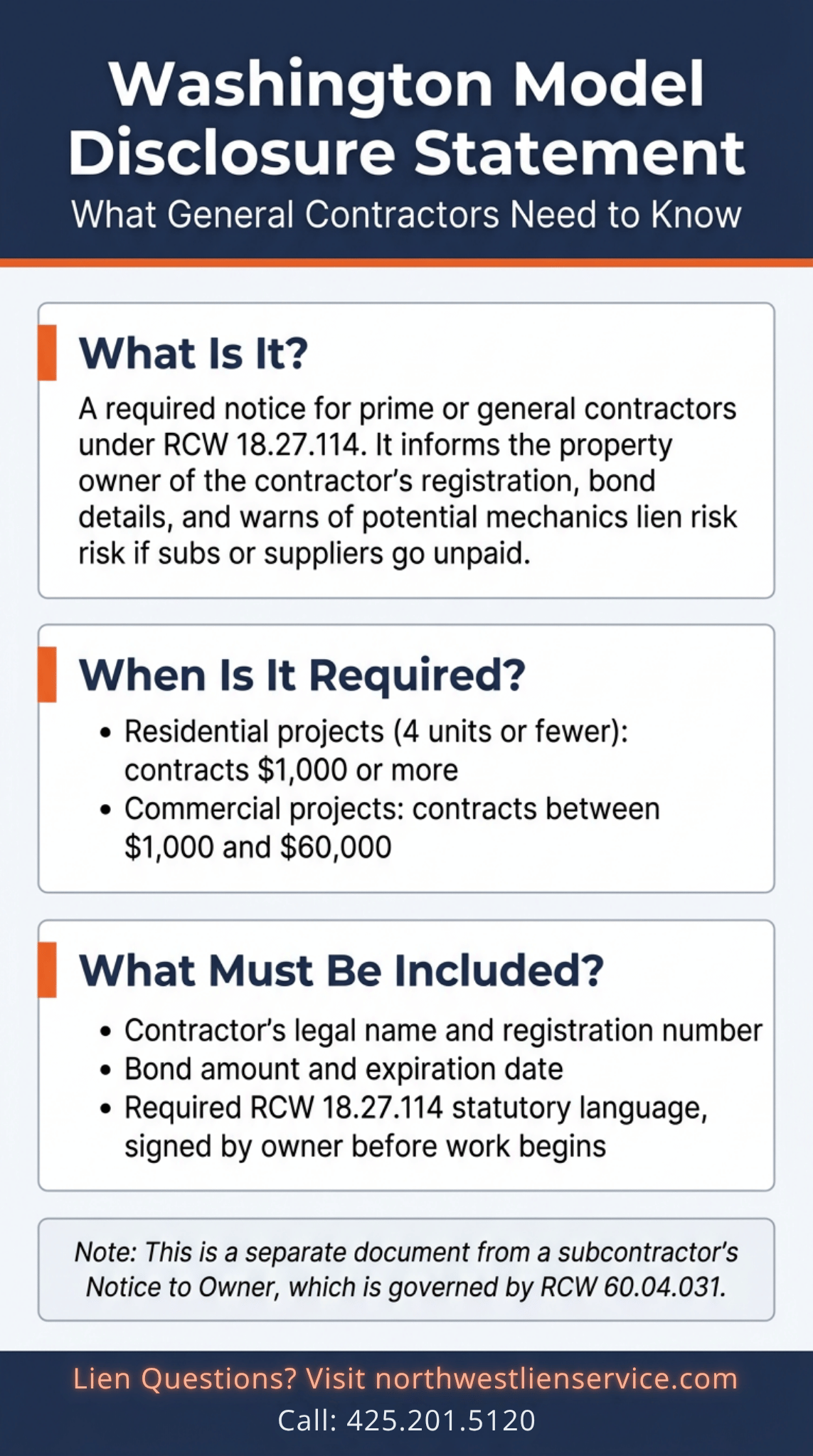
Infographics Guide: WA Model Disclosure Statement
A quick reference guide to RCW 18.27.114 requirements, project triggers, and what must be included in the statement.
FAQs: Washington Pre-Claim Notices
If a contractor in Washington does not provide the required disclosure statement under RCW 18.27.114, they cannot file or maintain a lien claim related to that contract. Failure to provide the disclosure is considered a violation that can lead to enforcement actions. No. Washington’s model disclosure requires the customer’s signature, and the state disclosure form says the contractor must be able to produce a signed or electronically signed copy on request. Notarization applies to the later Claim of Lien recorded with the county, not to the pre-contract disclosure itself. No. The Model Disclosure Statement applies to contractors who contract directly with the owner under RCW 18.27.114. Subcontractors and suppliers protect private-project lien rights through the separate pre-claim notice described in RCW 60.04.031. Generally, no. If you were required to send a Washington Notice to Owner and did not, you usually cannot enforce a mechanics lien for professional services, materials, or equipment. The main exception is a labor-only claim, because Washington law does not require the pre-claim notice for lien claims based strictly on labor.
Fill out the form to get your copy of the Model Disclosure Statement in PDF format from the Department of Labor & Industries for Washington State. Note: While Northwest Lien Service does not send this specific pre-contract form for you, we handle the complex Notice to Owner and Mechanics Lien filings. Not sure what document you need? Contact our lien specialists. Disclaimer: This article is for informational purposes only and does not constitute legal advice. Mechanics lien laws are complex and vary by jurisdiction. For specific legal guidance regarding your situation, please consult with a qualified attorney licensed in Washington. What happens if a general contractor does not provide the Model Disclosure Statement?
Does a Washington Model Disclosure Statement need to be notarized?
Can a subcontractor or supplier use the Model Disclosure Statement instead of a Notice to Owner?
Can I still file a Washington mechanics lien if I forgot to send a Notice to Owner?
Helpful Sources
Download Free WA Contractor Disclosure Form